
No products in the cart.
How Tallow Is Made from Cow and Goat
-
By rootallow
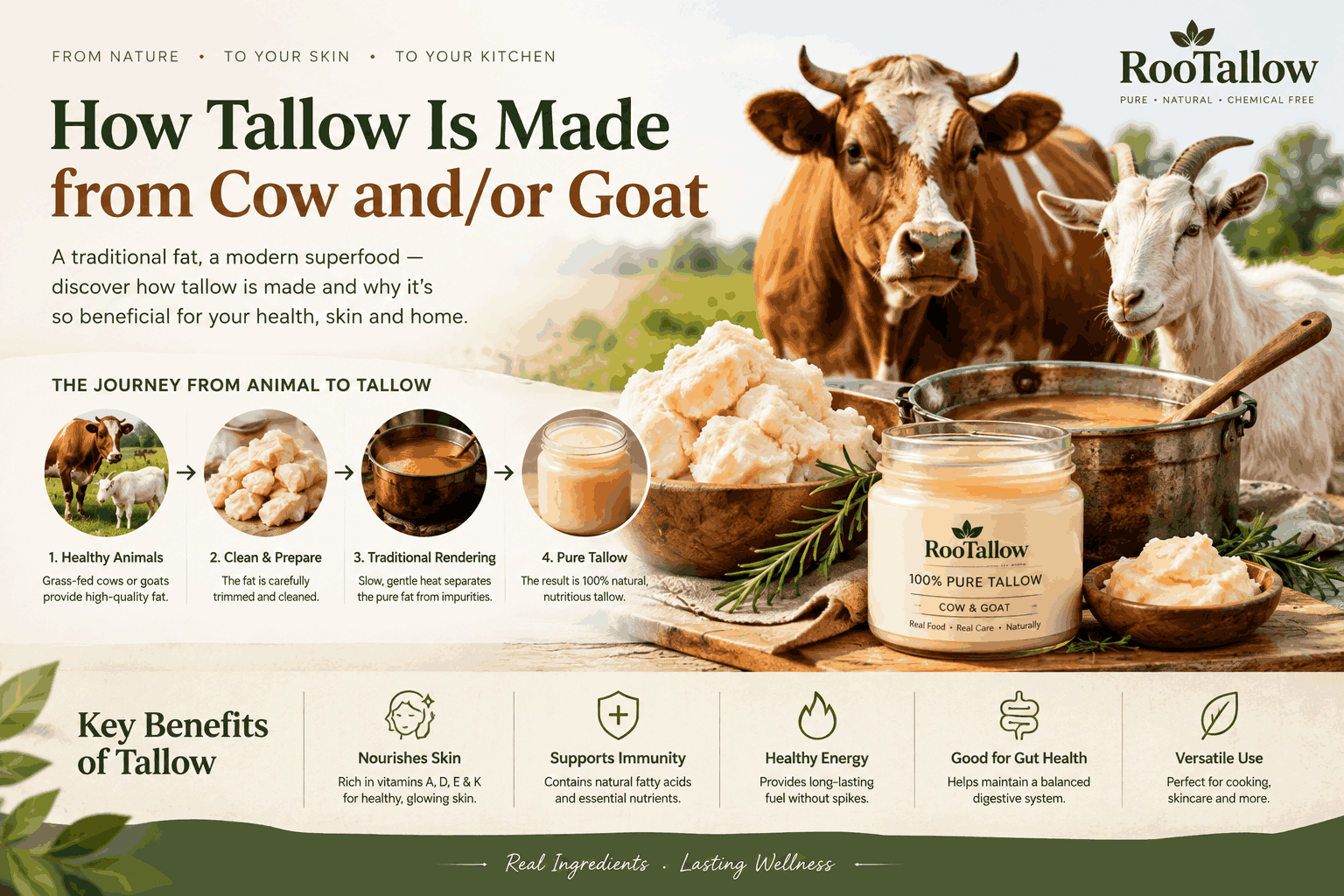
How Tallow Is Made: A Complete Guide to Its Benefits
For generations, people have used animal fats for cooking, skincare, and everyday household purposes. Before modern processed products became widespread, rendered animal fat was a valuable part of traditional life.
Today, tallow is making a comeback among people interested in traditional cooking, natural skincare, and minimally processed ingredients. But what exactly is tallow, how is it made from cows or goats, and what benefits does it offer?
At RooTallow, we believe in understanding the ingredients behind the products we use. In this guide, we explore the traditional process of making tallow and its practical applications in nutrition and personal care.
What Is Tallow?
Tallow is a rendered animal fat, traditionally obtained from cattle. The term is commonly used for fat from cows, while fat from goats and other animals may also be rendered for similar purposes.
The basic process involves separating usable fat from animal tissue, gently heating it to release the fat, and filtering the resulting liquid to remove solid impurities.
Once cooled, the rendered fat becomes solid or semi-solid, depending on its composition and storage conditions.
Important distinction: Tallow is not a chemical-free substance in the literal scientific sense—everything, including natural fats, consists of chemicals. At RooTallow, the term natural refers to ingredients and processing choices, rather than claiming that a product contains no chemicals whatsoever.
What Is the Difference Between Cow Tallow and Goat Tallow?
Although both come from ruminant animals, the source matters.
Cow Tallow (Beef Tallow)
Beef tallow is fat rendered from cattle. It is typically firm at room temperature and contains a mixture of saturated and unsaturated fatty acids.
Beef tallow can be used for:
- Cooking and frying
- Traditional food preparation
- Soapmaking
- Balms and other personal care products
The exact fat composition depends on the animal, its diet, and the fat tissue used.
AOCS
+1
Goat Fat (Rendered Goat Fat)
Goat fat is rendered from goat tissue and can be used for cooking and traditional personal care applications.
While people sometimes refer to it as goat tallow, goat fat and beef tallow should be clearly identified by their animal source. This is especially important when labeling products for customers.
How Tallow Is Made: The Traditional Rendering Process
Rendering is the process of extracting fat from animal tissue through heat. Proper preparation and hygiene are essential when producing fat intended for human consumption.
Glossary Item
+1
Step 1: Selecting and Preparing the Fat
The process begins with suitable fatty tissue from cattle or goats.
Depending on the intended product, this may include selected fat trimmings or other appropriate fatty tissues. The raw material should be obtained from healthy animals and handled hygienically.
The fat is cleaned and trimmed to remove unwanted tissue and visible impurities.
Quality begins with the raw ingredients. Fresh, properly handled fat is important for producing a suitable finished product.
Step 2: Cutting the Fat into Small Pieces
The cleaned fat is cut into smaller pieces.
This increases the surface area and helps the fat melt more evenly during heating. Some traditional methods use a slow-rendering process, while commercial operations may use specialized equipment.
The goal is to release the fat while controlling heat and minimizing contamination.
Step 3: Gently Heating the Fat
The prepared fat is placed into a suitable rendering pot or processing equipment.
As the fat warms, it gradually melts and separates from the remaining solid tissue. The temperature and duration depend on the rendering method and the intended use.
Traditional low-temperature rendering is one method used to obtain rendered fat, while other commercial methods use different processing conditions.
FAOHome
+1
Step 4: Filtering and Separating Impurities
After the fat has melted, it is filtered to remove solid particles and remaining impurities.
This step is important for achieving a cleaner final product. Commercial rendering also uses purification processes to control insoluble impurities.
Glossary Item
+1
Step 5: Cooling and Storage
The filtered liquid fat is transferred into clean containers and allowed to cool.
As it cools, it typically becomes solid or semi-solid. The final texture, color, and aroma depend on the animal source, processing, and purification.
Proper storage and protection from contamination help maintain product quality.
Benefits of Tallow: What Makes It Useful?
Tallow has several practical properties that make it valuable in cooking and personal care. However, its benefits should be distinguished from medical claims that have not been established by clinical evidence.
1. A Traditional Cooking Fat
Beef tallow can be used in a variety of cooking applications, including roasting, frying, and preparing traditional meals.
It contains a substantial proportion of saturated fat and has a relatively low polyunsaturated fat content compared with many vegetable oils. Its fatty acid composition contributes to its solid texture and cooking characteristics.
PMC
+1
Does Tallow Automatically Make Food Healthier?
Not necessarily. Tallow is an energy-dense fat, and its high saturated fat content is relevant to dietary choices.
Some clinical evidence indicates that replacing saturated fats with unsaturated fats can improve LDL cholesterol levels. Therefore, tallow should be used in moderation as part of an overall balanced diet rather than being presented as universally healthier than all seed oils.
JACC: Advances
+1
2. Useful for Natural Skincare
Rendered tallow is also used as an ingredient in balms, creams, and other personal care products.
Its rich lipid content can help create an occlusive layer on the skin, reducing moisture loss. This makes suitable tallow-based formulations useful for people looking for rich moisturization.
However, tallow is not a guaranteed treatment for eczema, acne, inflammation, or other skin conditions. Skin compatibility varies, and proper formulation, cleanliness, and patch testing matter.
Tallow in RooTallow Products
At RooTallow, animal fat can be incorporated into natural personal care products such as face balms, body butters, and lip balms.
The value of a product depends not only on the natural origin of its ingredients but also on the quality of sourcing, formulation, storage, and manufacturing practices.
3. A Source of Dietary Fat
Tallow provides energy because dietary fat contains approximately 9 calories per gram.
It can be part of a balanced eating pattern, alongside protein, vegetables, fruit, whole grains, and other nutrient-dense foods. However, tallow is not a complete food and does not supply all the vitamins and minerals needed for good health.
The nutritional value of a meal depends on the complete diet, not simply whether it contains an animal fat or a plant oil.
4. A Versatile Natural Ingredient
One of the reasons rendered fats remain popular is their versatility.
Depending on the formulation and intended use, tallow can be incorporated into:
- Cooking fats
- Body balms
- Lip care products
- Traditional soaps
- Other personal care preparations
Its texture and stability can make it useful in products designed for specific applications.
Beef Tallow vs. Goat Tallow: Which Should You Choose?
The right choice depends on how you plan to use the product.
| Feature | Cow Tallow | Goat Fat |
|---|---|---|
| Source | Cattle | Goats |
| Common use | Cooking and skincare | Cooking and skincare |
| Texture | Often firm | Varies by source and processing |
| Composition | Depends on tissue and diet | Depends on tissue and diet |
| Main consideration | Purity and intended use | Purity and intended use |
Neither source should automatically be described as medically superior. Both require appropriate sourcing and processing.
How to Choose Quality Tallow in Pakistan
If you are purchasing tallow for cooking or skincare, consider the following:
1. Know the Animal Source
Check whether the product is made from cow, goat, or another animal. Clear labeling helps you understand what you are buying.
2. Look for Proper Processing
Ask about the rendering and filtering process. Products intended for eating should be manufactured under suitable food safety practices.
3. Check the Ingredients
For personal care products, review the full ingredient list, especially if you have sensitive skin or known allergies.
4. Store It Properly
Follow the manufacturer’s storage instructions. Heat, moisture, and contamination can affect product quality.
RooTallow: Natural Ingredients, Thoughtful Processing
At RooTallow, our focus is on natural body care and traditional ingredient-based products.
Tallow is an example of how animal-derived ingredients can be used in modern personal care and cooking. Understanding how it is sourced, rendered, and formulated helps consumers make informed decisions.
We believe that choosing natural ingredients should go hand in hand with responsible manufacturing, transparent labeling, and realistic product expectations.
Conclusion: Understanding Tallow from Source to Finished Product
Tallow is a rendered animal fat that has practical uses in cooking and personal care. Whether it comes from cow or goat, the basic principle is to extract fat from suitable tissue through rendering, followed by filtering and appropriate handling.
Its texture, fatty acid composition, and versatility make it an interesting traditional ingredient. At the same time, its saturated fat content means that dietary use should be considered within an individual’s overall nutritional needs.
For skincare, tallow-based products can offer rich moisturization, but their suitability depends on formulation and individual skin response.
Natural living starts with understanding what we use—not simply assuming that everything natural is automatically better or risk-free.
Explore RooTallow’s natural ingredient approach and discover how traditional fats can be incorporated into everyday personal care.